Laura is a devoted advocate with Death with Dignity in Massachusetts, inspired by her husband Scott’s ongoing battle with ALS. As Scott’s caregiver and partner, she has witnessed firsthand how terminal illness can strip away independence, comfort, and control. Now, Laura is working alongside advocates across the state to help pass the End of Life Options Act (H2505/S1486) and ensure that terminally ill Massachusetts residents have access to compassionate, dignified end-of-life options.

In April 2021, my husband Scott woke up with fasciculations—spontaneous muscle contractions—rippling all over his body. It was frightening and completely out of nowhere. Scott was only 38 years old and had always been healthy. He had never had any major medical issues. He barely even went to the doctor. But that morning, something felt so wrong that he went straight to the emergency department.
A physician told him it could possibly be ALS.
Even writing that now still doesn’t feel real. ALS was something we had heard of, but it wasn’t something that belonged in our lives. It didn’t make sense. Scott was strong, active, and full of energy. We were building our future. We had a two-year-old at home, and I had just found out I was pregnant with our second child. We were supposed to be in the middle of the happiest chapter of our lives—not learning how to live inside a terminal diagnosis.
For the next two years, Scott did everything he could to prove that doctor wrong. He saw specialist after specialist. He tried different treatments. We held onto hope that this was something else—anything else. But eventually, we were led back to the same place: ALS. A disease with no cure.
Before ALS: The Life We Thought We Had
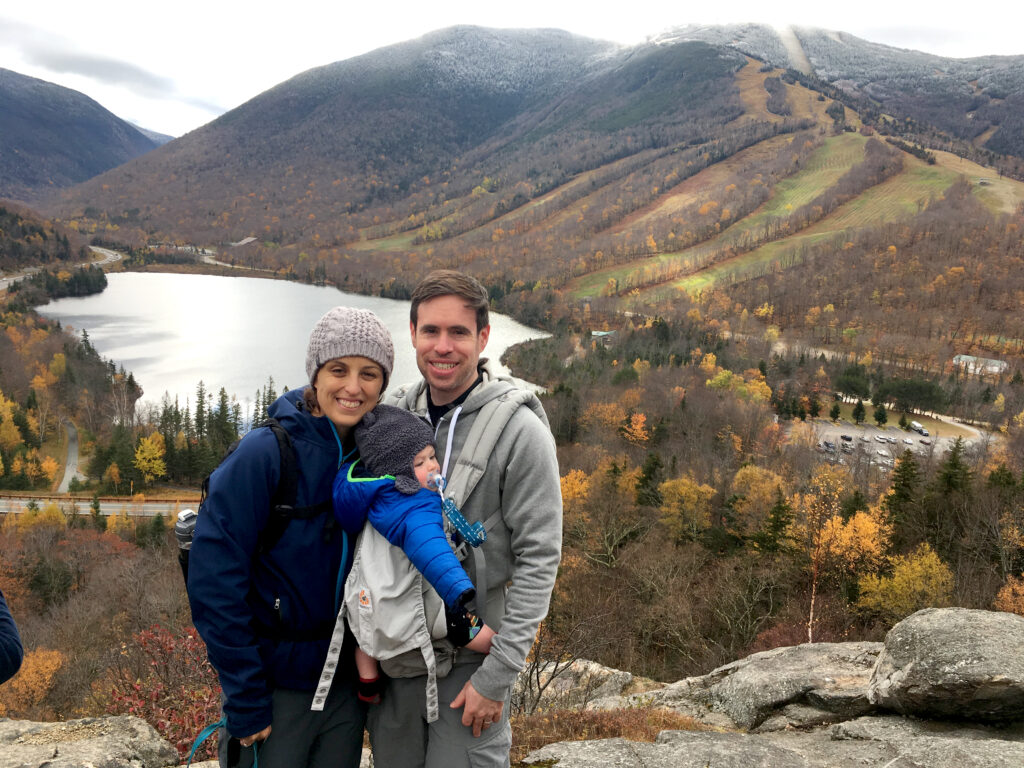
Before ALS, Scott and I lived for adventure. We met in Baltimore, Maryland at a bar, and realized we lived just down the street from each other. We immediately connected over our love of the outdoors, travel, and exploring new places.
Over the years, we traveled throughout the U.S. and across the world—Thailand, Indonesia, Iceland, Guatemala, and South Africa. We hiked mountains and volcanoes. We even hiked the Grand Canyon in one day. Our life was full of movement, possibility, and shared discovery.
We had hoped to share our interests with our children, but ALS has taken that away piece by piece.
Watching a Terminal Illness Take Everything
Scott’s symptoms have progressed more slowly than many people with ALS, and I know that sounds like a blessing. But slow progression doesn’t mean it’s easier. It means watching the person you love lose their body one function at a time and being in a constant state of grief and trauma, over years, while his mind stays fully intact.
It also means watching him grieve his own life in real time.
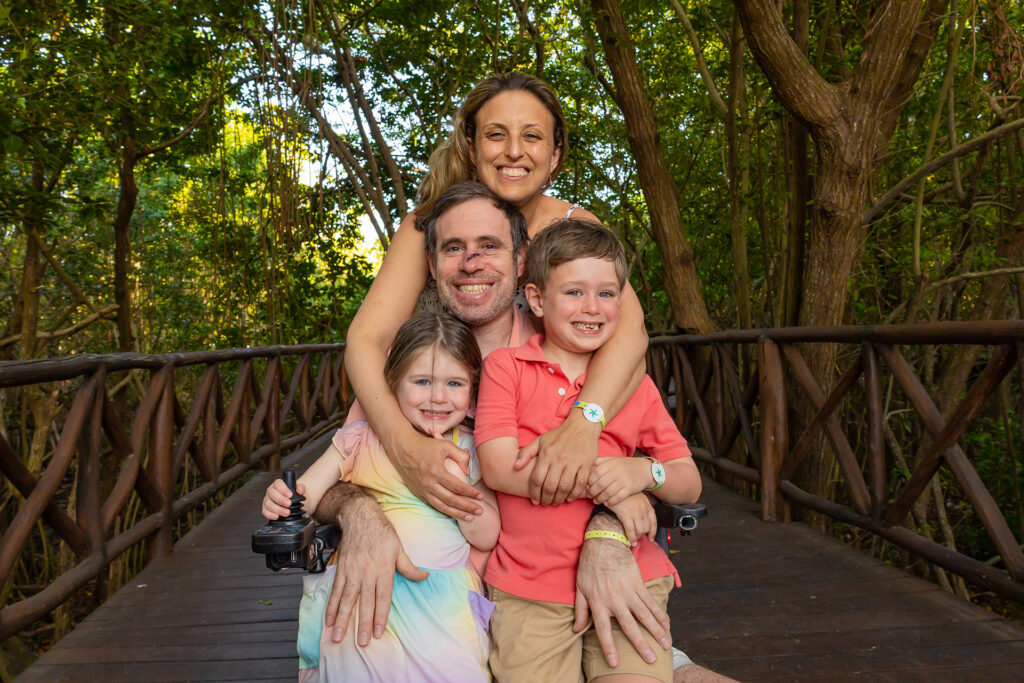
Scott has lost function in his legs and is now completely wheelchair bound. His arm strength is weakening. His breathing is beginning to be affected. He can’t drive anymore. He can’t bathe or dress himself independently. He can’t pick up our children or run around with them the way he used to.
And yet, he continues to show up in every way he still can, for himself, as a father, and husband.
Scott is a biomedical engineer and still works remotely managing a team, which he is proud of. But even that is becoming harder as his voice fatigues and typing becomes more difficult. Still, he keeps going. He refuses to disappear from the life he has built.
Finding Meaning and Joy While Preparing for the End of Life
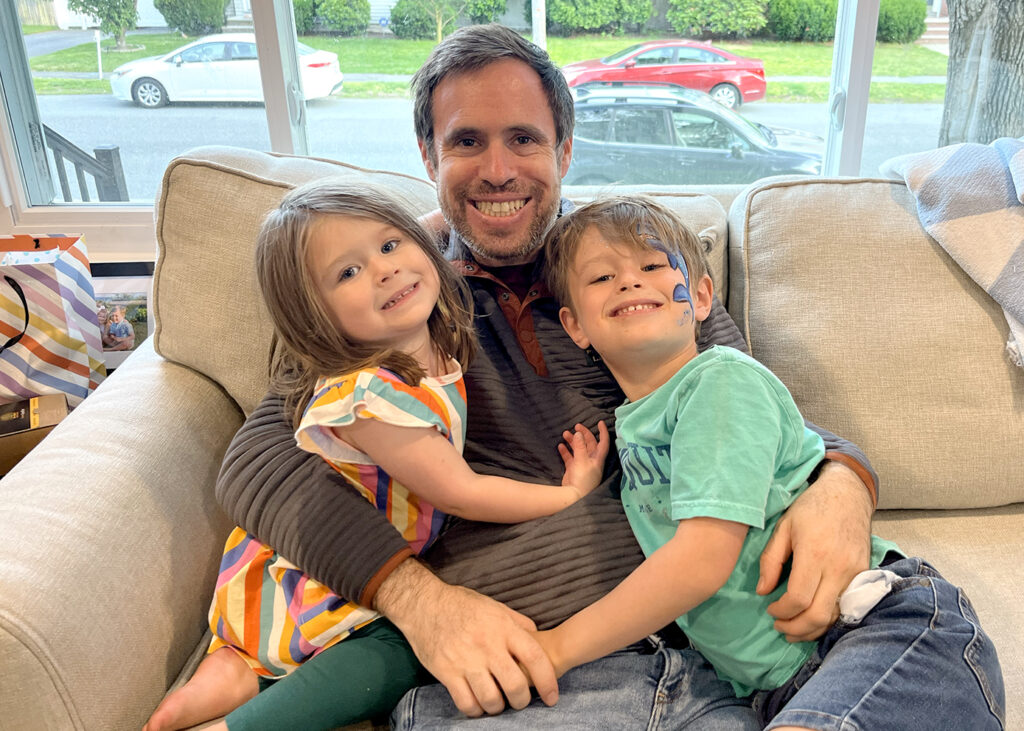
Scott stays positive by focusing on what he can do. He reads books with our kids. Plays cards. Participates in their imaginative play. Does science projects with them. He goes to their activities whenever possible.
A few years ago, we even did adaptive whitewater rafting through Team Gleason. Right now, he’s focused on doing a duo team for the Boston Marathon with a friend. Scott has always been determined, and ALS hasn’t taken that from him.
But there are quieter moments too—when the house is still, and you can feel everything we are losing sitting right alongside everything we are still trying to hold on to.
Honoring Scott’s Wishes: Quality of Life and End-of-Life Choice
From the beginning of his diagnosis, Scott has been clear about one thing: his quality of life matters most. To him, that means being able to communicate, participate in our children’s lives, and maintain as much independence and dignity as possible.
He has also been adamantly against machines keeping him alive. He is already in daily pain. Without breathing and feeding tubes, the end stages of ALS can mean prolonged suffering and a deeply painful death.
Scott has said many times that he does not want that.
He wants the ability to decide when it is time—not because he wants to die, but because he wants to live fully for as long as he can, and then be able to face the end without unnecessary suffering. Scott wants control over how he dies. He wants to be at home, in the only place that still feels like us, surrounded by his family—not in panic or pain, and not in a hospital room filled with machines and strangers.
Unfortunately, Death with Dignity is not yet a legal end-of-life option here in Massachusetts, and it continues to break my heart for Scott and for so many other families like ours.
We have considered looking into states like Vermont that have medical-aid-in-dying (MAID) laws, but traveling would be incredibly difficult with Scott’s physical limitations. And the truth is, he shouldn’t have to leave his home to access compassion. He shouldn’t have to cross state lines to have autonomy over his own dying process.
Some days I feel like I am grieving him while he is still here, because I can already see pieces of him leaving long before his body does. As his caregiver for nearly five years, I can say this is the hardest experience of my life.
ALS takes so much. It takes freedom. It takes dignity. It takes the future you thought you had.
Why End-of-Life Choice Matters for Families Like Ours
That’s why I am speaking out now, while Massachusetts lawmakers are once again considering the End of Life Options Act (H2505/S1486). This bill would allow mentally capable, terminally ill people to request MAID, so they can avoid unbearable suffering at the end of life.
For our family, Death with Dignity would mean that Scott could have control over the end, even after ALS has taken control over everything else. And because our kids are still so young, it would give us the chance to prepare them, to help them understand, and to let them say goodbye in a way that is rooted in love—not trauma.
I believe every terminally ill person deserves the right to choose a peaceful death. No one should be forced to suffer simply because their state refuses to act. Scott deserves compassion. Our family deserves compassion. And so do countless other families living through terminal illness in Massachusetts, and across the country.
Take Action: Share Your Story
ALS has taken so much from Scott—his mobility, his independence, his privacy, and future moments we once assumed we’d have. But what it hasn’t taken is his ability to think clearly, to love deeply, and to know exactly what he wants when the suffering becomes too great.
What breaks my heart is that even with a terminal diagnosis, even with the reality we live every day, Massachusetts law still denies him the most basic form of compassion: his own freedom to choose a peaceful, humane death at home, surrounded by the people he loves.
Even though I love Scott and it’s hard for me to imagine a future without him, I deeply respect his wishes and how he wants to face the end of his life. I’m sharing our story because I don’t want Scott’s voice to be ignored.
And I know we are not the only family in Massachusetts, or beyond, quietly carrying this kind of grief.
If you or someone you love has faced a terminal illness, I hope you’ll find the courage to share your story too. Stories are what lawmakers remember. They can move hearts into action. Our experiences are what turns a law into a lifeline.