“Taking the medicalization of death and bringing it back to community and family and spirituality—that’s what I think a good death is.” – Peg Sandeen
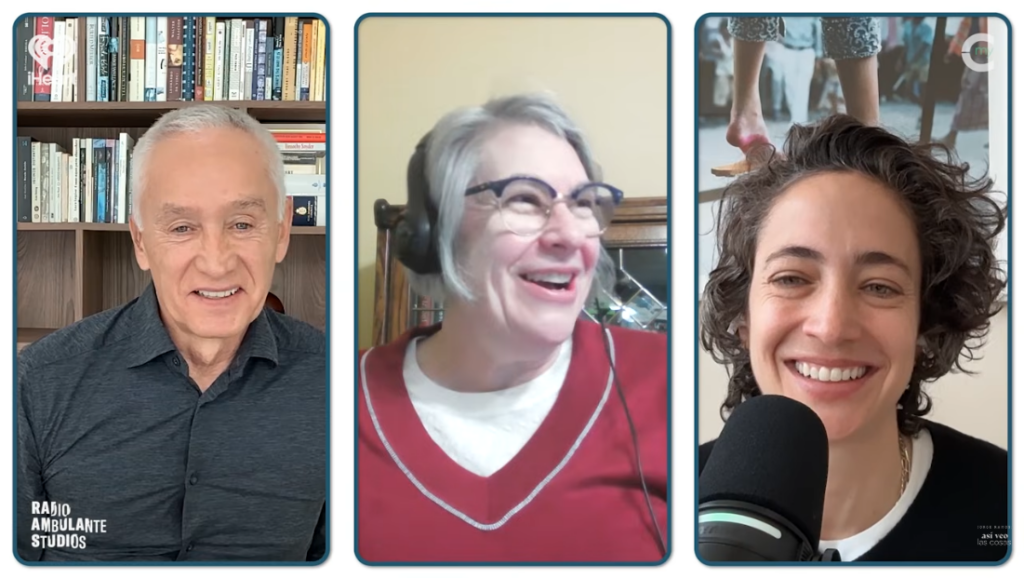
How do we honor agency at the end of life? Shortly after Governor Hochul signed New York’s medical-aid-in-dying law, our Death with Dignity CEO, Peg Sandeen, joined hosts Jorge Ramos and Paola Ramos on their podcast The Moment. Their thoughtful conversation explores how the law works, the deeply personal decisions patients choose to make, and the complex feelings of confronting the end of life.
In case you missed it, we’ve highlighted some of the key takeaways that answered Jorge Ramos and Paola Ramos’ questions about Death with Dignity in the U.S.
What is Medical Aid in Dying?
The interview opens with a discussion of New York becoming the 14th jurisdiction to pass a medical aid-in-dying law, a hard-won milestone more than a decade in the making. The New York statute aligns with the established “U.S. model.” Across all Death with Dignity laws, patients must have a terminal diagnosis with a prognosis of six months or less to live, make a voluntary request on their own behalf, possess the capacity to make their own healthcare decisions, and be able to self-administer the medication.
While every state with a medical-aid-in-dying law adheres to these four core criteria, each sets its own guidelines around waiting periods, which healthcare providers may participate, and residency requirements.
The incorrect terminology was also discussed, such as “assisted suicide” and “euthanasia”—language that is not accurate to medical aid in dying and Death with Dignity laws in the U.S. Opponents often use inflammatory and incorrect language, like assisted suicide because death remains a taboo and often frightening subject for many people in the United States. The opposition weaponizes language to stop medical-aid-in-dying legislation from passing through state legislatures.
Euthanasia is illegal in every state across the country. This is the act of someone administering end-of-life medication to the patient, and is commonly thought of as lethal injection, and sometimes referred to as “mercy killing.”
Public Perception of Death with Dignity
In New York, it took more than a decade to pass medical-aid-in-dying legislation. The need for the law was there, but the understanding wasn’t. Physicians needed time. Lawmakers needed time. And in a culture that so often looks away from death, many people needed time to even ask themselves the most basic, human question: What do I want my death to look like?
And yet, beneath that hesitation, something has been shifting. About 70% of people in the United States now support medical aid in dying. This can be seen as a reflection of countless reckonings: people beginning, however tentatively, to face what it means to die, and how they want to live until then.
The Need for Medical Aid in Dying at the End of Life
“We die differently than our grandparents and our great-grandparents, and our deaths tend to have much more suffering associated with them.”
During the podcast, the topic of what a good death looks like was discussed. Peg is all about the basics when describing her version of a “good death.” She talks about alignment, about a person’s final days reflecting who they are and what matters to them.
“Taking the medicalization of death and bringing it back to community and family and spirituality—that’s what I think a good death is.”
Medicine can do extraordinary things—it can stretch time, keep hearts beating, hold off the inevitable a little longer. But extra time doesn’t always feel like living. Sometimes it looks like more procedures, more waiting, more pain. And at the same time, patients and loved ones want those final days or weeks—to sit together, to say what needs to be said, to hold onto one another a little longer. Medical aid in dying can offer a kind of clarity in that space, a way for people to shape those last moments instead of being carried by them.
There are questions that rise to the surface at the end of life, the ones that don’t have easy answers: What has my life meant? What will my death mean? What do I want the people I love to carry with them when I’m gone? There’s a tenderness in that kind of reflection. For some, it opens the door to forgiveness. For others, it’s about naming love out loud or finding a sense of completion. Having some measure of control over the timing can make room for those conversations to unfold with intention, rather than in the chaos of a crisis.
The Power of Storytelling at the End of Life
To close the podcast conversation, Jorge Ramos shared, “I didn’t know how it was gonna go, this conversation… I thought it was gonna be so difficult to talk about death. And somehow, you made it much, much easier.”
That’s why storytelling matters so deeply to our organization. Personal stories are a bridge between private experience and public understanding. When people share their end-of-life stories—their fears, their hopes, their choices—it begins to open up the silence that so often surrounds death, and can move hearts and minds.
Whether you are living with a terminal illness, have lost someone you love, or believe in personal autonomy and dignity at the end of life, you can help expand and protect Death with Dignity laws in your state by sharing your story.