By Emma Granquist Houghton, MSW
A Surreal Premise
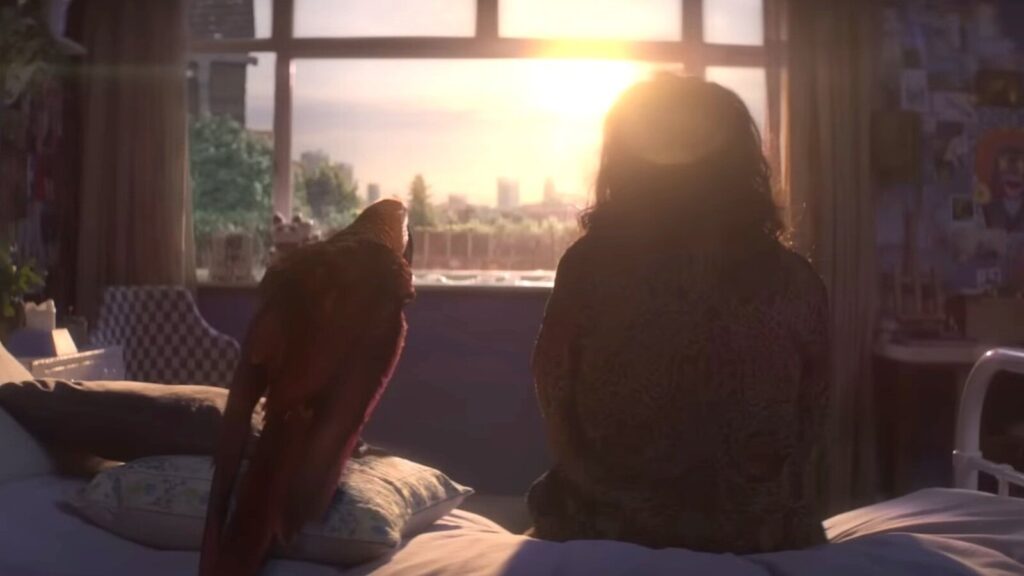
Last summer, there was a quiet but persistent buzz among my fellow Death with Dignity social workers about a film that seemed, at first, completely removed from the world I work in every day. Tuesday, starring Julia Louis-Dreyfus, presents a surreal premise where death takes the form of a talking macaw. At first, it felt like a stretch. I wasn’t sure it could capture the real-life complexities of end-of-life care. Could something so fantastical speak to the raw, grounded realities of death?
Death, in Another Form
In many films, death appears as a grim, cloaked figure, designed to frighten us; a symbol of the unknown. What I appreciated about Tuesday was its radically different portrayal: death as a shimmering, otherworldly bird. Mysterious and wise, it arrives not to haunt, but to accompany, a quiet, steady presence alongside a terminally ill teenager and her grieving mother. As they move through the slow, painful process of letting go, the bird doesn’t push or pull. It simply remains. Bearing witness and holding space for the vast, complex emotions that arise at the end of life.
As a social worker, I saw myself in that bird. That simple, quiet presence—a reminder that, in the face of the most difficult moments, it’s not about doing or saying the perfect thing. It’s about showing up, without judgment or expectation.
The Power of Presence in End-of-Life Care
One of the first things I learned as a social worker in the medical aid in dying space is that compassionate presence is everything. It’s not about having the right words or fixing what cannot be fixed — presence is simply about being there — fully and willingly, without rushing someone through their grief or silencing their fear.
Sometimes presence means sitting quietly with someone after a devastating diagnosis, letting them speak, or not, on their own terms. Sometimes it’s a call with a daughter overwhelmed by the weight of exhaustion, guilt, and love. Other times, it’s helping a patient name what matters most as they near the end of life, making space for clarity, peace, or unresolved conflict.
These moments shape how we die, more than just the physical process, but the emotional, spiritual, and relational landscape of our final days. And they shape how those left behind make meaning of the loss. Whether someone feels heard, held, or honored at the end-of-life can echo for years with those who loved them.
That’s the power of presence. It doesn’t need to be dramatic or profound. Presence just needs to be real.
Stories That Help Us Say Goodbye
Going into Tuesday, I was skeptical. I wasn’t sure I could see myself, either as a social worker or simply as someone who’s known grief, reflected in a fantastical bird. But I was wrong. Sometimes, it takes an unexpected story to shift our perspective. Personal narratives have the power to educate and challenge misconceptions about medical aid in dying, often mischaracterized as euthanasia or assisted suicide, when in truth, it’s about bodily autonomy and end-of-life freedom. Medical aid in dying offers a peaceful option for the deeply personal decisions of people facing terminal illness.
Talking about end-of-life issues can be hard. Maybe a bird isn’t your preferred way to explore conversations on dying, and that’s okay. The magic of films can offer alternative ways to open the door for discussion. A dance scene in Barbie provides a lighthearted, existential question with friends, and The Wild Robot navigates feelings of loss with children, to name a few. More grounded resources like documentaries on medical aid in dying may help you connect with your own experience of loss in a way that feels more personal and real.
As a social worker, I’m always seeking out films that feature the quieter, often unseen aspects of dying, the emotional undercurrents, the tender moments of connection, the unspoken fears, and the life-giving moments at the end of life. The stories that resonate with me most are the ones that explore the complexity of what it means to say goodbye.
What films have helped you reflect on dying, grief, or what it means to live fully? Which characters or moments in film have helped open the door to conversations you didn’t know how to start, whether with loved ones, with yourself, or with the realities we all must one day face?